Domowina honours individuals for their commitment to Sorbian language and culture
15.10.2026
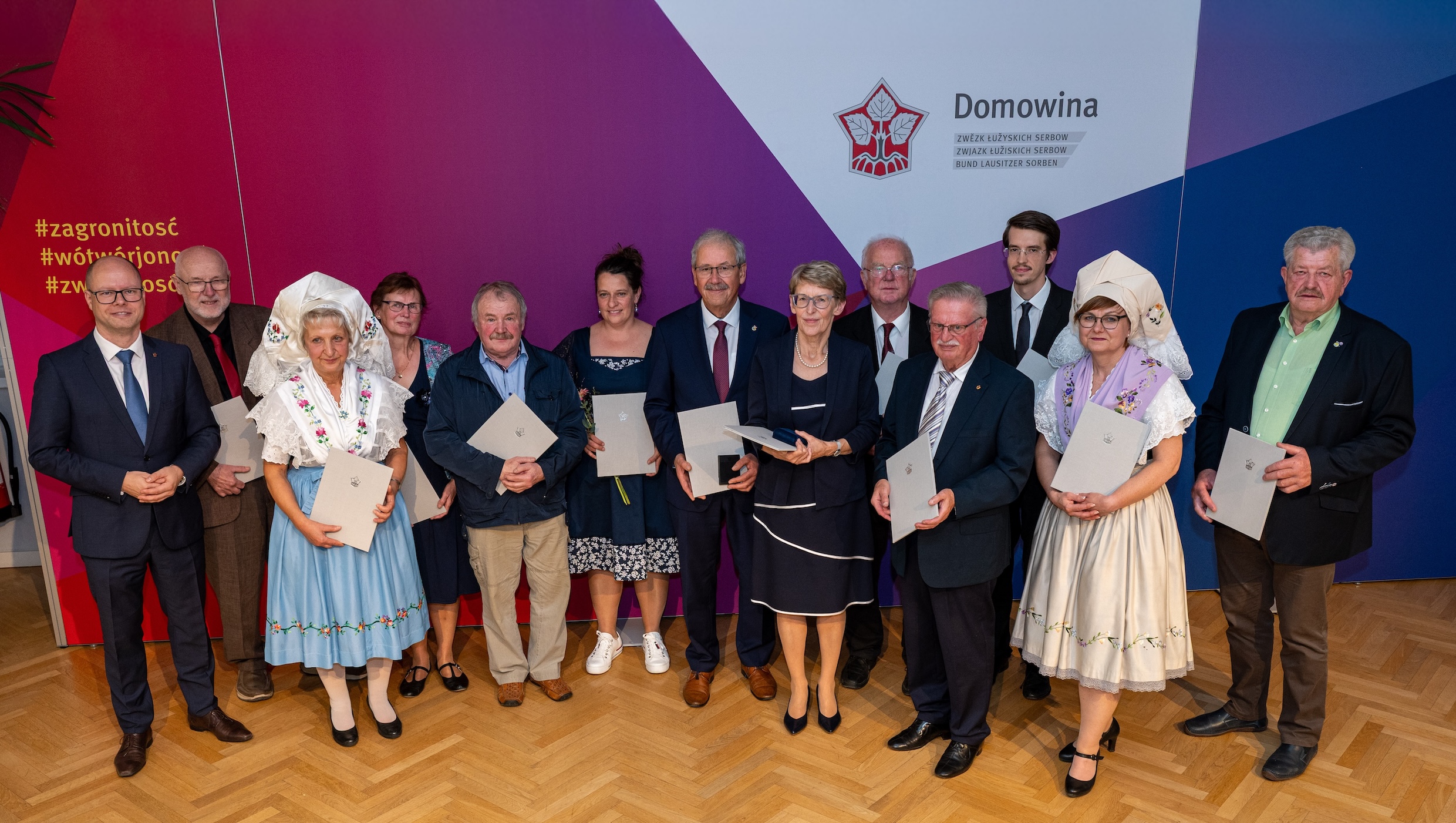
Domowina, the umbrella organisation of the Lusatian Sorbs and a member organisation of FUEN, has honoured individuals for their outstanding commitment to the Sorbian community. At an award ceremony held on 14 October, three individuals received the Domowina Prize, while eight others were awarded the Domowina Badge of Honour. The awards recognise their long-standing efforts to preserve and promote Sorbian language, culture and identity.
“It is not laws or structures that hold our people together, but the individuals who are committed to their homeland, the Sorbian language and identity,” emphasised Domowina Chair Dawid Statnik in his welcoming address.
The 2026 Domowina Prize was awarded to Borbora Felberowa from Komorow/Commerau, Kito Ela from Chóśebuz/Cottbus and Ludwig Sachsa from Radwor/Radibor. All three have shaped Sorbian community life in different ways over many years.
Borbora Felberowa has been working to preserve Sorbian language and culture for decades. From 2003 to 2019, she served as press spokesperson and personal adviser at Domowina. Since 2008, she has chaired the Domowina local group Commerau-Truppen-Königswartha and also serves as Deputy Chair of the “Jan Arnošt Smoler” Regional Association. Her initiatives include Sorbian language and educational programmes as well as the revival of regional traditions, including the traditional maypole ceremony in Commerau. Bringing Sorbian and German residents together is particularly important to her.
Kito Ela has made significant contributions to promoting the Lower Sorbian language and education in Lower Lusatia. As the long-serving head of the Lower Sorbian department of the WITAJ Language Centre in Cottbus, he played a key role in advancing early childhood Sorbian language education. He also served on Domowina's Federal Board and represented Lower Lusatia in Germany's Minorities Council until 2024. Even in retirement, he continues to promote exchanges between Upper and Lower Lusatia and advocate for the interests of the Sorbian community.
Ludwig Sachsa combines decades of involvement in Maćica Serbska and the Cyril and Methodius Association with practical educational and environmental work. At the “Dr. Maria Grollmuß” Sorbian Primary and Secondary School in Radibor, he teaches young people practical craft skills and shares knowledge about their home region. Through projects he has developed, including a forest park with trilingual information boards, he also promotes the visibility of Sorbian-German bilingualism. For almost two decades, he documented the activities of Maćica Serbska through photography.
In addition to the three prize winners, eight individuals received the Domowina Badge of Honour. The recipients were Doreen Šymańcowa (Schiemenz), Marlies Nagorina (Nagora), Siegmund Lehmann, Antonín Kříž, Florian Kießlich, Christin Rißmanowa (Rißmann), Jurij Wjesela and Martina Pečikowa (Petschick).
Their contributions reflect the diversity of Sorbian cultural activities. Doreen Schiemenz and Marlies Nagora are particularly committed to preserving and passing on Lower Sorbian customs and traditions. Siegmund Lehmann works to preserve traditional Wendish fishing practices in the Spreewald region, while Antonín Kříž has promoted cultural relations between Sorbs and Czechs for decades. Florian Kießlich reaches young people in particular through his involvement in Sorbian associations, digital educational initiatives and his music with the Sorbian hip-hop group Nowa Doba. Christin Rißmann introduces children in the Schleife region to Sorbian language and traditions. Jurij Wjesela preserves Sorbian cultural heritage through his craftsmanship, artistic work and involvement in the Sorbian men's choir “Delany”. Martina Pečikowa, among other activities, promotes the visibility of Sorbian language, traditional costumes and local history as Chair of the Tätzschwitz Heritage Association.
In his acceptance speech, Kito Ela, who has been a member of Domowina for more than 63 years, highlighted the responsibility that comes with working for the Sorbian community: “Working under the umbrella of Domowina means more than simply being involved in an association. You inform people, you tell them about the Sorbs and their history. You have an educational responsibility. We are passionately committed to the Sorbian people.”
The awards highlight the many different forms that efforts to preserve a minority language and its culture can take. These range from language courses and educational projects to maintaining traditional customs, contemporary music and digital initiatives. At the heart of these efforts are people who take responsibility and pass on their knowledge to younger generations.
The FUEN Working Group of Slavic Minorities (AGSM) congratulates all recipients of the Domowina Prize and Badge of Honour and thanks them for their many years of dedication. Their commitment makes an important contribution to the future of the Sorbian community and demonstrates the importance of voluntary work among Europe's Slavic minorities.
The award ceremony was accompanied by musical performances by Walburga Walde and Izabela Kałduńska, featuring songs in both Lower and Upper Sorbian.
Photo: Domowina/Bojan Benić